Current probes

Home > Products > Measuring Instrument > Current probes > Details
100MHz/1500V High Voltage Differential Probe

100MHz/1500V High Voltage Differential Probe

0
This high-voltage differential probe is designed for accurate measurement of high-voltage floating signals, safely measuring the voltage difference between two non-ground-referenced test points. It features switchable 50X / 500X attenuation and safely measures differential voltage up to ±1500 V. Its high input impedance greatly reduces loading effects on the DUT and ensures measurement accuracy. An optional bandwidth limit suppresses high-frequency noise for cleaner waveforms.
Performance
❯ Motor drive and inverter testing
❯ Power converter and inverter analysis
❯ Switching power supply design and debugging
❯ High-voltage floating signal measurement and troubleshooting
Key Features
❯ Standard BNC output connector
❯ Industry-leading high-stability CMRR technology
❯ Zero adjustment function with electronic touch-key design
❯ Comprehensive probe accessories for complex test scenarios
❯ Industry-leading low-distortion waveform measurement technology
Downloads

You may also be interested in these products

Product Parameter

  • Model
  • TR1010B
  • Bandwidth (-3dB)
  • 100 MHz
  • Rise Time
  • ≤3.5 ns
  • Accuracy
  • ±2%
  • Range (Attenuation)
  • 50×/ 500×
  • Max. Differential Voltage (DC+Peak AC)
  • 500× ±500V / 500× ±1500V
  • Max. Input to Ground (Vrms)
  • 600 V CAT III / 1000 V CAT II
  • Input Impedance
  • Single-Ended (to GND): 5 MΩ ±1% / Two Inputs: 10 MΩ ±1%
  • Input Cap
  • Single-Ended (to GND): <4 pF / Two Inputs: <2 pF
  • CMRR
  • DC:>80 dB / 100 kHz: >60 dB / 1 MHz: >50 dB / 3.2 MHz:>30 dB / 50 MHz: >26 dB

Product Details

1689235810411851.png

High performance differential probe

From the laboratory to the production line, BNC compatibility makes the differential probe a multi-scenario test tool to meet the verification requirements of low-temperature start-stop and high-temperature conditions of the motor controller. The probe is equipped with a variety of measuring accessories, which can be quickly replaced to complete the measurement and debugging.

Measuring advantages

For the SiC electric drive system of electric vehicles, the differential probe withstands ± 1400V transient high voltage and 6000Vrms isolation voltage, and the dual high impedance input channels directly measure the phase-to-phase voltage of the three-phase inverter, eliminating the risk of 50A ground loop current in traditional measurement. CAT II safety level establishes a safety barrier for 800V battery pack charging and discharging tests, helping engineers to complete power system verification with zero fear of electric shock.

1682751213592601.jpg
1682751239835596.jpg

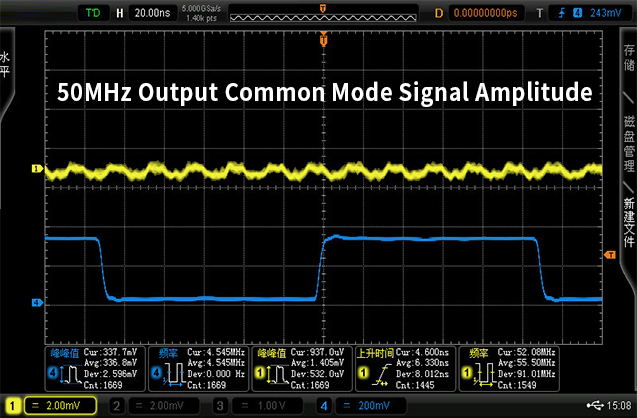
CMRR Common Mode Rejection Capability

When measuring GaN/SiC half-bridge circuit with sub-probe, 80dB ultra-high common mode rejection ratio can compress 500V common mode voltage to mV level interference, and accurately capture Vgs drive details with 5ns dead time. The probe supports 100V/ns ultra-fast dV/dt change, and the aluminum nitride ceramic isolation medium withstands the double pulse test of 1700V silicon carbide devices, ensuring zero distortion in the loss analysis of the third generation semiconductor switch.

low voltage power supply

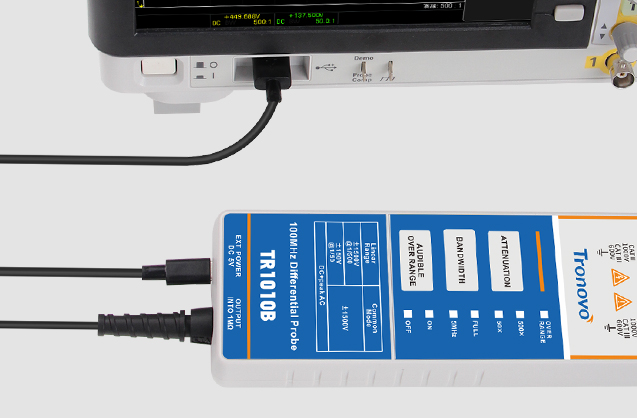
Through the oscilloscope built-in USB interface or external 5V power adapter power supply, using Type-C interface to achieve positive and negative blind plug, support plug and play function. Can provide up to 2A stable current, built-in overvoltage/overcurrent protection circuit. The Type-C cable is widely compatible with existing digital equipment, and the mobile phone charging cable can be directly borrowed to achieve rapid deployment in the laboratory environment.

1682751269879445.jpg
1682751335156602.jpg

pulse signal measurement

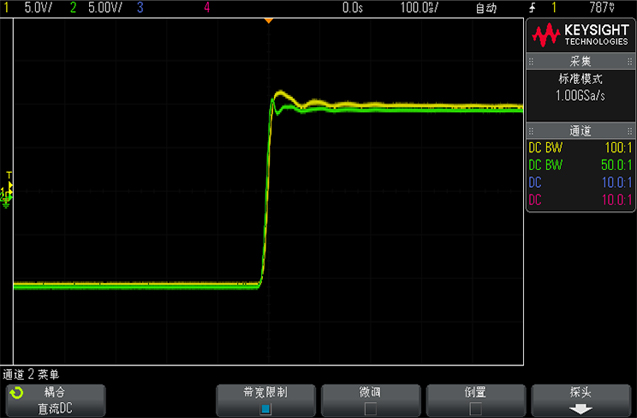
When comparing the rising edge responses of different probes, it is found that the waveform of the contrast probe has obvious ringing phenomenon. This phenomenon is mainly caused by insufficient probe bandwidth or transmission line impedance mismatch, and high-speed signals produce reflection superposition in the probe-oscilloscope path. It is recommended to use an active differential probe with a bandwidth ≥ 3 times the signal frequency to ensure that the input impedance is ≥ 1MΩ, which can effectively suppress ringing. With the oscilloscope 20MHz bandwidth limit function, can further optimize the signal integrity, so that the rise time measurement error <5%, in line with the IEEE1155 standard requirements.

.

Product Video

TAG:

Related Articles