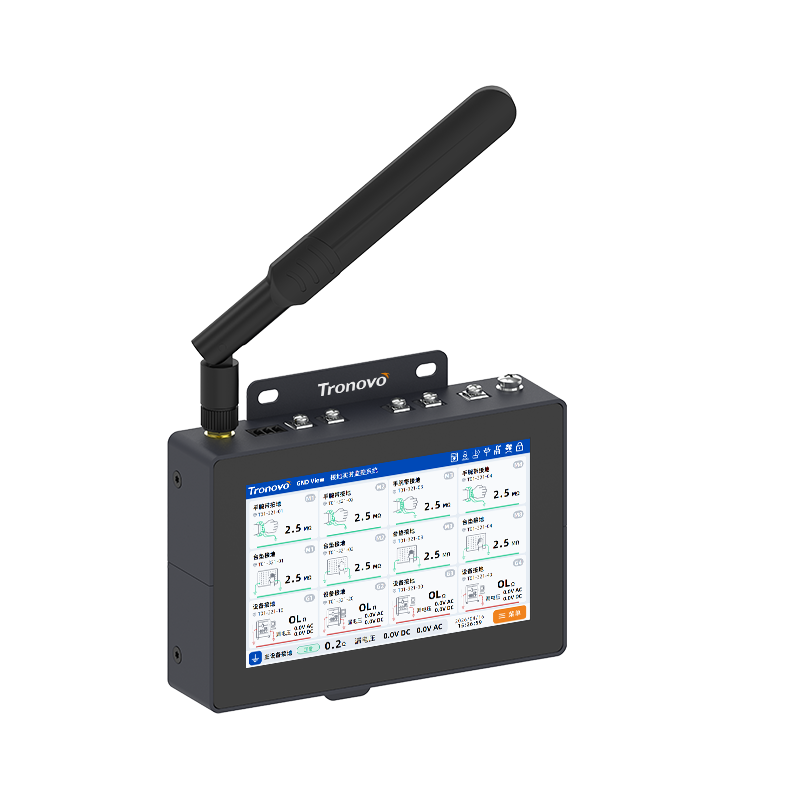
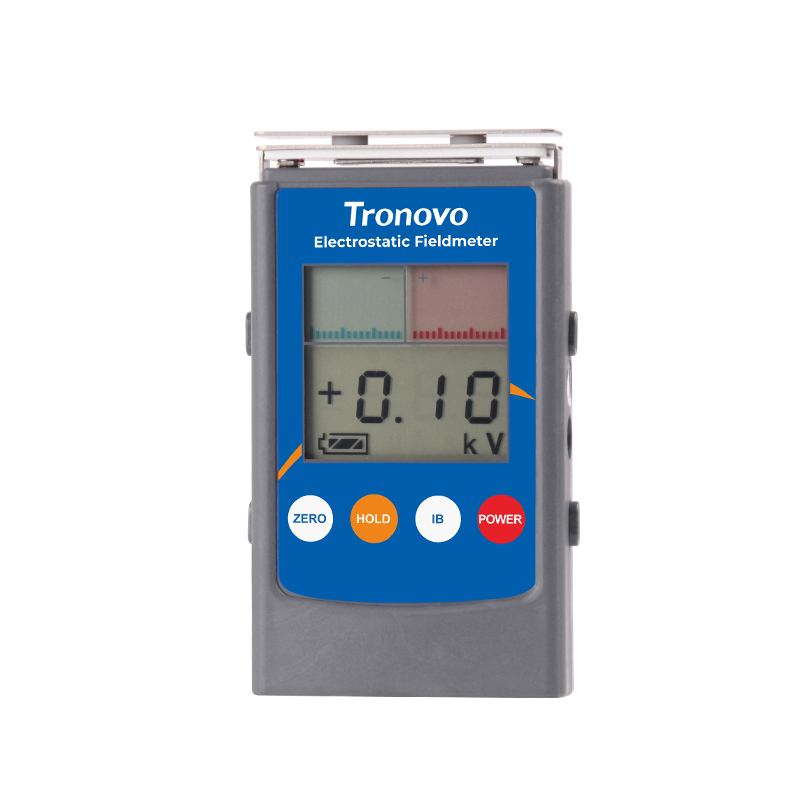
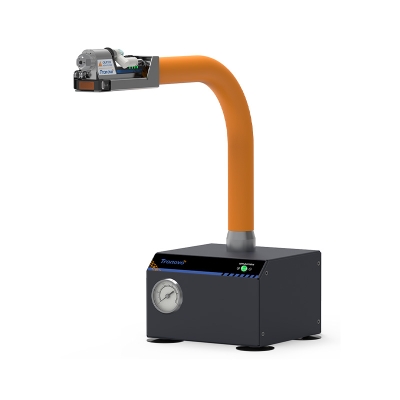
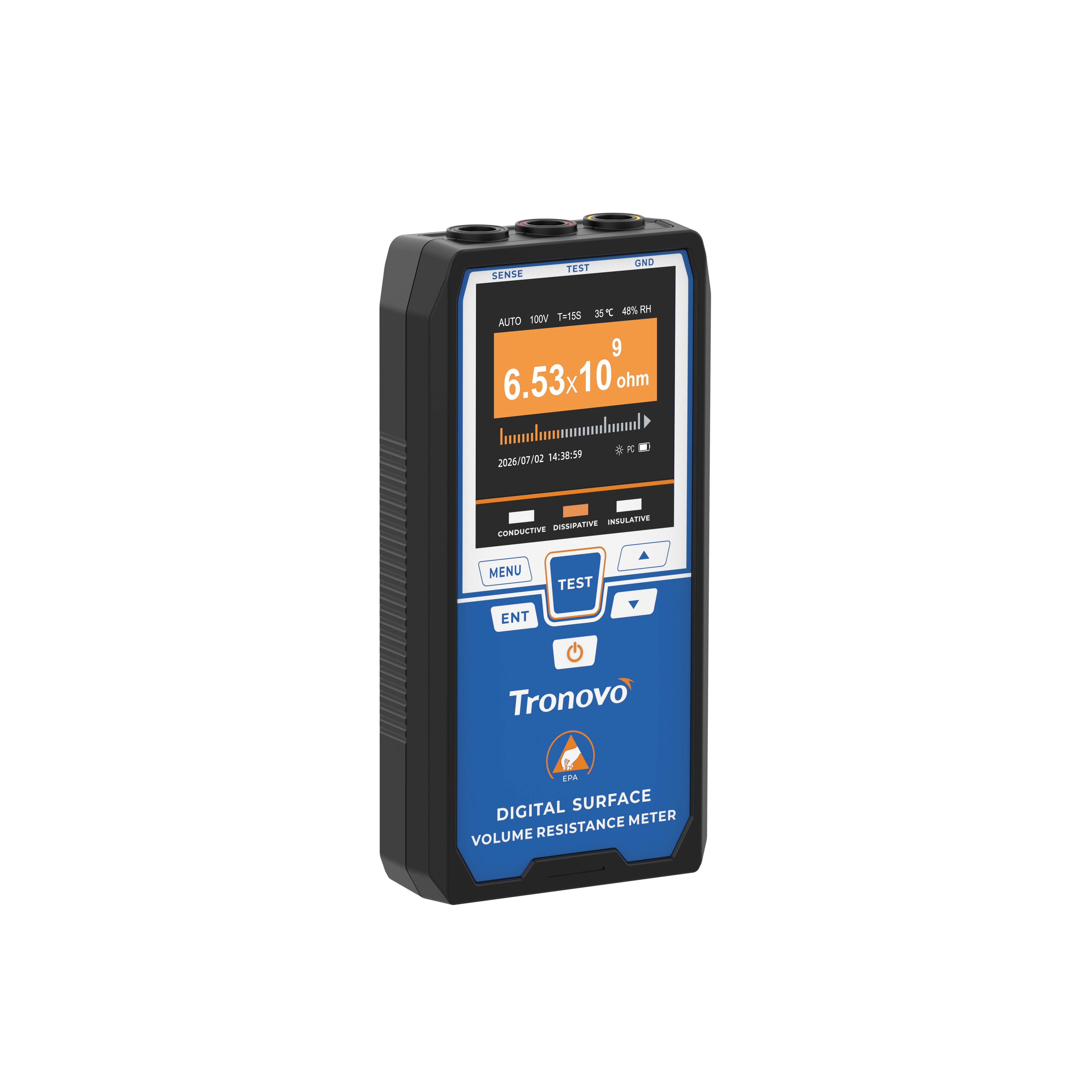
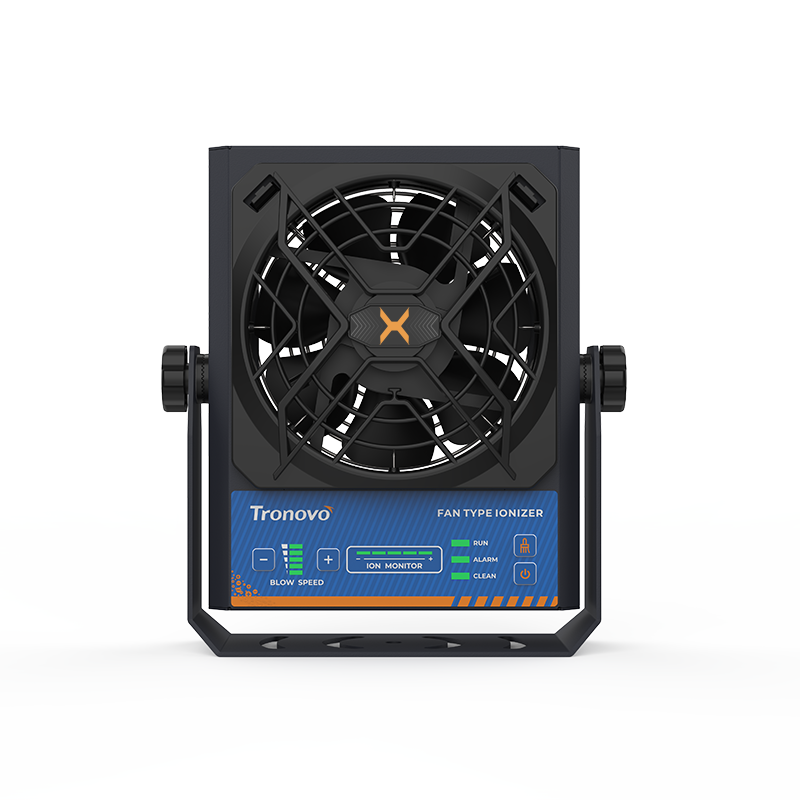
Conclusion in advance: There are six basic methods to prevent and control electrostatic hazards in industrial production – Earthing, Personnel ESD Protection, ESD Flooring & Work Surfaces, Ionization for Static Neutralization, Humidity & Process Control, ESD Packaging. Static charge on conductors can be dissipated via earthing. For insulators such as plastic films and epoxy boards, static charge cannot be removed by earthing; ion neutralization technology must be adopted. The ionizing bar (static elimination bar) is the primary device used on production lines for on-line static neutralization of wide, continuously moving insulating materials.
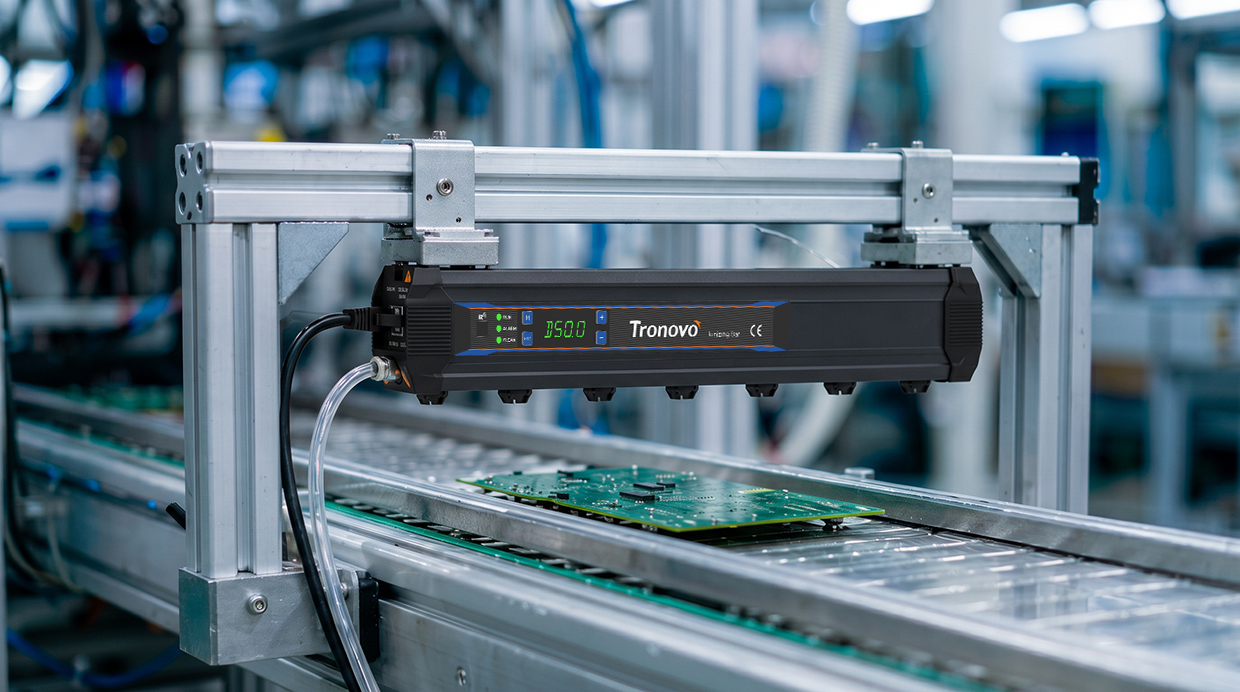
In SMT production lines, TRONOVO pulsed AC ionizing bars are installed above conveyors to perform continuous on-line static neutralization on moving PCBs.
I. What are the basic methods to prevent electrostatic hazards in industrial production?
Six basic methods for industrial static hazard control, classified by target objects. The core rule: Static on conductors is dissipated by earthing; static on insulators is neutralized by ionization. The six methods, key parameters and standard references are listed in the table below.
| Basic Method | Working Principle | Applicable Objects | Key Indicators & Standard References |
|---|---|---|---|
| 1. Earthing | Directly dissipate static charge on conductors to ground | Equipment, frames, workbenches, metal fixtures | Hard earthing: connection resistance from technical elements to common earth point ≤1.0 Ω (ANSI/ESD S6.1 §6.4.1); current-limiting resistor 1 MΩ for personnel earthing, refer to ANSI/ESD S1.1 |
| 2. Personnel ESD Protection | Wrist straps, heel straps, ESD shoes & garments to ground human body | All operators entering EPA (ESD Protected Area) | Total resistance of wrist strap system <3.5×10⁷ Ω (ANSI/ESD S20.20-2021) |
| 3. ESD Flooring & Work Surfaces | Floors and work surfaces form charge dissipation paths | Workshop floors, workbench surfaces, conveyor base plates | Surface resistance <1.0×10⁹ Ω (per ANSI/ESD STM97.1) Human body walking peak voltage <100 V (measured per ANSI/ESD STM97.2) |
| 4. Ionization Static Neutralization | Ionize air to generate positive and negative ions to neutralize surface charge on insulators | Insulating materials, film rolls, materials and stations that cannot be earthed | Ion balance ≤±35 V (ANSI/ESD S20.20-2021, tested per ANSI/ESD STM3.1) |
| 5. Humidity & Process Control | Increase humidity to reduce static generation; reduce peeling / friction speed | Workshop environment, film slitting, printing, powder conveying | Common industry practice: maintain relative humidity 40%~60% RH, verified by process |
| 6. ESD Packaging | Shielding bags and turnover boxes isolate external electrostatic fields | Storage and transportation of Static Sensitive Devices (SSD) | Surface/volume resistance <1.0×10¹¹ Ω (Dissipative: 1×10⁴ ~ <1×10¹¹ Ω; Conductive: <1×10⁴ Ω, ANSI/ESD S541-2019) |
Static sensitive devices are classified by Human Body Model (HBM): per ANSI/ESDA/JEDEC JS-001-2023, Class 0 devices have static susceptibility below 250 V. Static generated by daily human activities can reach thousands to tens of thousands of volts. Without protection, static in production can cause latent damage. ESD damage is concealed and latent: devices may pass immediate testing but suffer premature failure in service due to hidden damage. This is why ESD protection must be implemented as a full system instead of only checking instant defect rates.
II. Why must static charge on insulators be neutralized by ionized air?
Earthing only dissipates static charge on conductors. Insulating materials such as plastic film, epoxy boards, ceramics, dust particles and shipping packaging have high resistivity. Surface charges cannot be drained through ground wires. Measures such as body earthing, bench earthing and floor earthing are completely ineffective for these charges.
For static on insulator surfaces, the only effective engineering solution is ion neutralization: positive and negative ions generated by air ionization adsorb and cancel opposite charges on material surfaces. Ionizing bars target exactly these non-groundable insulating surfaces and high-speed moving charged materials in roll-to-roll and conveyor processes. This explains why ionizing bars are standard equipment for SMT post Underfill dispensing & curing, film slitting, printing and die-cutting processes.
III. What is an ionizing bar (static elimination bar)? What is its working principle?
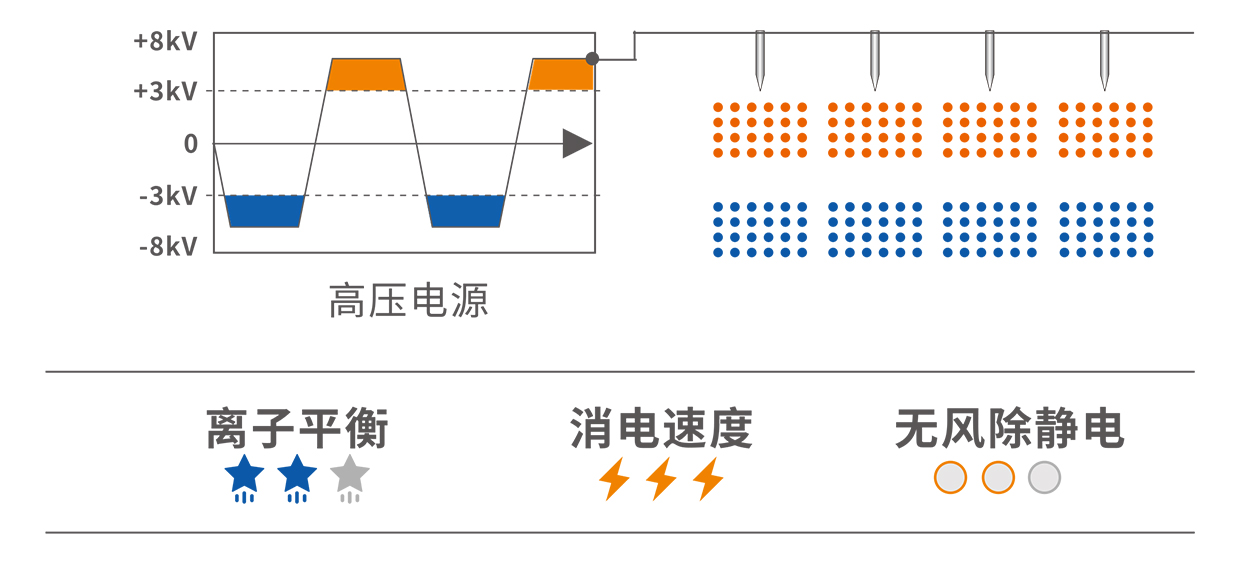
An ionizing bar (also called static elimination bar) is a bar-type static eliminator. High-voltage electrodes and a row of stainless steel discharge needles are installed inside an aluminum profile. When connected to high voltage power supply, the needle tips generate corona discharge to ionize surrounding air molecules and produce equal quantities of positive and negative ions. When charged materials pass in front of the bar, ions with opposite polarity are attracted to the material surface to complete neutralization.
TRONOVO pulsed AC ionizing bar from ETA Instruments (Suzhou) Co., Ltd adopts pulsed AC corona discharge principle. Discharge needles alternately emit positive and negative ions. The bar features self-cleaning property, slow dust accumulation on needles and is suitable for long-term continuous production lines. TRONOVO pulsed AC ionizing bar uses 24 V DC low voltage power supply with integrated high-voltage module inside the body. Built-in digital display and status indicator show real-time neutralization status. No external high voltage power box required for installation and inspection.
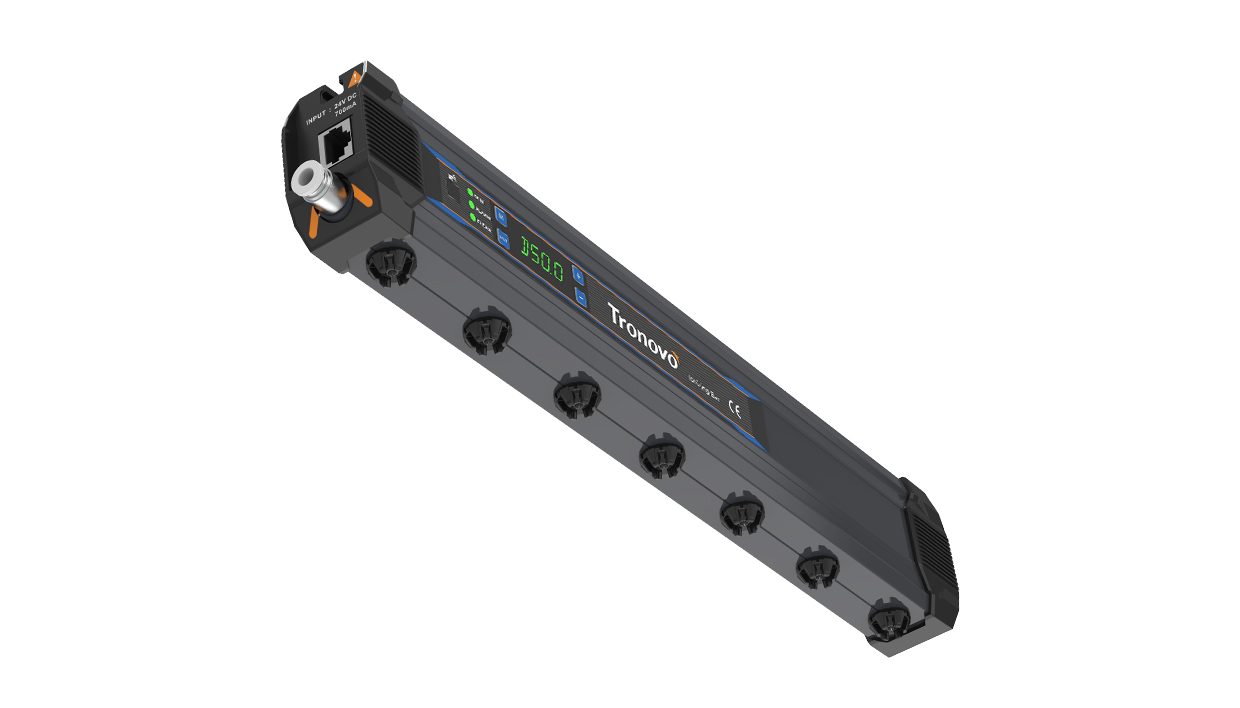
TRONOVO pulsed AC ionizing bar physical photo: dark grey body with integrated high voltage module, front digital display and status indicators showing real-time operating parameters, 24 V DC power supply, mounting feet at bottom of bar.
IV. What are the characteristics of ionizing bars?
Compared with ionizing fans and ionizing guns, ionizing bars focus on three keywords: wide coverage, on-line operation, no disturbance. Six typical features of TRONOVO ionizing bars:
Wide effective coverage. Single ionizing bar covers effective width from 300~3000 mm. Length customizable according to machine width; one single bar can fully cover full-width film or whole conveyor transversely.
Zero / low air flow, no material disturbance. Ionizing bars without fan structure produce no airflow, suitable for processes where film vibration or dust flying must be avoided. TRONOVO zero-air ion bars are specially designed for static elimination in film industry without airflow disturbance. Compressed dry air can be added to build air-assisted bars for stronger ion delivery when needed.
Flexible mounting options. Aluminum profile with built-in mounting slots, can be mounted horizontally, vertically or inclined directly onto machine frames, roller brackets or conveyor guards without major machine modification.
Suitable for continuous on-line static elimination. Supports long-time continuous operation matching roll-to-roll and continuous conveyor production rhythm. Static charge is neutralized instantly as material passes the bar.
Controllable ion balance. Per ANSI/ESD S20.20-2021 requirement, offset voltage (ion balance) of ionizing equipment shall be controlled within ±35 V to prevent reverse charging and damage to static sensitive devices.
Concentrated maintenance points, low workload. Only discharge needles require routine maintenance. Cleaning and replacement can be performed outside machine, short downtime.
V. Which parameters to check for ionizing bar selection?
Ionizing bar selection shall not only consider price and length. Verify six parameters in the table below and request supplier’s test report. ETA Instruments (Suzhou) Co., Ltd can provide measured performance data for TRONOVO products tested per ANSI/ESD STM3.1-2024.
| Selection Parameter | Definition | Reference Value | Test / Verification Method |
|---|---|---|---|
| Ion Balance (Offset Voltage) | Residual voltage generated by unbalanced quantity of positive and negative ions on object surface | ≤ ±35 V (ANSI/ESD S20.20-2021) | Charge Plate Monitor, per ANSI/ESD STM3.1-2024 |
| Decay Time (Neutralization Speed) | Time required for test plate voltage to drop from 1 kV to 100 V | Common industry acceptance: 3~5 s, subject to process and customer requirements | ANSI/ESD STM3.1 or IEC 61340-4-7 |
| Effective Coverage Width | Transverse range with valid static neutralization | Standard range 300~3000 mm, customizable | Supplier’s measured test report |
| Working Distance | Distance from discharge needle tip to charged material surface | Most models: 30~150 mm; air-assisted version can extend distance | Manufacturer installation manual |
| Air Requirement (Air-assisted bar) | Pressure and quality of compressed air | Typically 0.2~0.5 MPa, must be dry, clean and oil-free | Check against process air specification |
| Environmental Compatibility | Cleanroom class, oil mist, dust, corrosive atmosphere | Low outgassing material for cleanroom; explosion-proof certified model for flammable gas environment | On-site environment assessment |
VI. What to note for ionizing bar installation & layout?
Same ionizing bar may achieve vastly different neutralization effect with different mounting positions. Follow five layout principles:
Maintain distance within 30~150 mm. Too far: lower ion arrival rate and slower neutralization. Too close: risk of vibration interference and disturbance by metal parts. Most models recommend 30~150 mm, refer to manufacturer manual.
Bar facing charged surface as normal as possible. Discharge needle direction shall be nearly perpendicular to material surface; deflection angle shall not exceed 30° from normal line.
Install downstream of highest static generation point. Prefer mounting 50~100 mm downstream of peeling points, roller outlets and friction conveyor sections where static generation is strongest, to allow sufficient time for ion neutralization.
Avoid metal shielding and nearby earthed metal parts. No metal rollers or guards blocking ion stream in front of bar. Maintain ≥50 mm clearance from surrounding earthed metal components to prevent electric field distortion and efficiency drop.
Properly fix high voltage module and cables. High voltage module / power supply placed away from operators and water sources. High voltage cables cannot be folded, knotted or rubbed against sharp machine edges; apply clear marking.
VII. Notes for daily operation & maintenance of ionizing bars?
Installing ionizing bar does not guarantee valid performance. Most failures are caused by contaminated discharge needles and ion balance drift. Follow seven rules for TRONOVO ionizing bar daily operation and maintenance:
High voltage safety first. Ionizing bar power supply outputs several thousand volts. Cut off power and wait for full discharge before cleaning and maintenance. High voltage cable cannot be folded or rubbed against sharp edges. Lockout-Tagout procedure must be followed during service.
Clean discharge needles periodically. Dust, oil mist and solder paste contamination blunt needle tips and reduce neutralization efficiency significantly. General workshop: clean every 2~4 weeks with anhydrous alcohol and lint-free swabs. Cleanroom: extend to 1~3 months, adjust based on site pollution level.
Visual inspection of needle condition weekly. Check bent, broken or oxidized discharge needles. Replace with original needles immediately if damaged to avoid ion balance drift.
Calibrate ion balance quarterly. Use Charge Plate Monitor (CPM) to measure ion balance per ANSI/ESD STM3.1-2024. If exceeding ±35 V, clean needles first. Repair or replace if still out of tolerance after retest.
Include in routine ESD check. Spot-check material surface potential before & after static elimination using electrostatic voltmeter. SMT and Underfill curing stations shall add to daily/weekly check log with records.
Adjust maintenance cycle according to environment. Shorten cleaning cycle for heavy oil mist / dusty environment. Use low outgassing version for cleanroom. Explosion-proof certified model is mandatory for flammable gas atmosphere; ordinary ionizer is prohibited.
Document records into ESD system files. Log cleaning, calibration and replacement records into periodic verification plan required by ANSI/ESD S20.20-2021 for audit traceability.
Common Misunderstanding Reminder: Malfunction of ionizing bar (needle contamination, balance drift) not only fails to eliminate static, but may also charge materials reversely and damage static sensitive devices. Therefore residual voltage test and needle cleaning are NOT optional maintenance items, but mandatory periodic verification activities under ANSI/ESD S20.20-2021.
VIII. FAQ
Q1: What are the basic methods to prevent electrostatic hazards in industrial production?
Six categories: Earthing, Personnel ESD Protection (wrist strap / ESD clothes & shoes), ESD Flooring & Work Surfaces, Ionization Static Neutralization, Humidity & Process Control (40%~60% RH), ESD Packaging. Core rule: conductors dissipate static via earthing, insulators rely on ion neutralization. System requirements refer to ANSI/ESD S20.20-2021.
Q2: Does ionizing bar need fan or compressed air?
Not mandatory. Zero-air ionizing bar (such as TRONOVO zero-air ion bar) delivers ions by electric field without airflow, suitable for film and dust-sensitive processes that cannot tolerate air disturbance. Compressed dry air (0.2~0.5 MPa typical) can be added for air-assisted bar when working distance is large or material carries heavy static charge, to accelerate ion transportation.
Q3: How to select between ionizing bar and ionizing fan?
Ionizing fan comes with built-in fan, covers local workstation area, suitable for workbench and inspection stations. Ionizing bar has wide coverage (300~3000 mm), can be embedded into machine, no airflow disturbance, suitable for roll film, conveyor and continuously moving linear materials. Combination of both is widely used on production lines.
Q4: How to verify ionizing bar performance?
Two quantitative criteria: 1) Compare surface potential before and after static elimination by electrostatic voltmeter spot test; 2) Measure offset voltage with Charge Plate Monitor (CPM) per ANSI/ESD STM3.1-2024 and keep within ±35 V required by ANSI/ESD S20.20-2021.
Q5: Can ionizing bar blow toward human body? Is it harmful to people?
Ionizing bar generates positive/negative ions and trace ozone. Ozone concentration under normal operation is far below occupational exposure limits. No electric shock hazard – discharge needle current is microampere level. However high voltage power supply is hazardous; power must be cut before maintenance. Low ozone model available for ozone-sensitive cleanroom environments.
References:ANSI/ESD S20.20-2021 Electrostatic Discharge Control Program Requirements; ANSI/ESD STM3.1-2024 Ionization Test Methods; ANSI/ESD S6.1-2019 Earthing; IEC 61340-5-1:2024 Electrostatics – Part 5-1: Protection of electronic devices against electrostatic discharge; ANSI/ESD S541-2019 Packaging materials for ESD sensitive items; ANSI/ESDA/JEDEC JS-001-2023 Human Body Model (HBM) device ESD susceptibility classification. All values are general acceptance references. Final acceptance criteria subject to latest standard text, customer audit requirements and product measured test report.